
Powering The Therevox Shop
October 18th, 2026 posted by mike under Workshop Updates.Almost all of the electricity to run the Therevox shop comes from renewable power, mostly from hydroelectricity. In August, Melissa and I took an 11 hour road trip north to visit the Manic-5 dam located near the “Eye of Quebec” at the Manicouagan Reservoir to see where our electricity comes from.
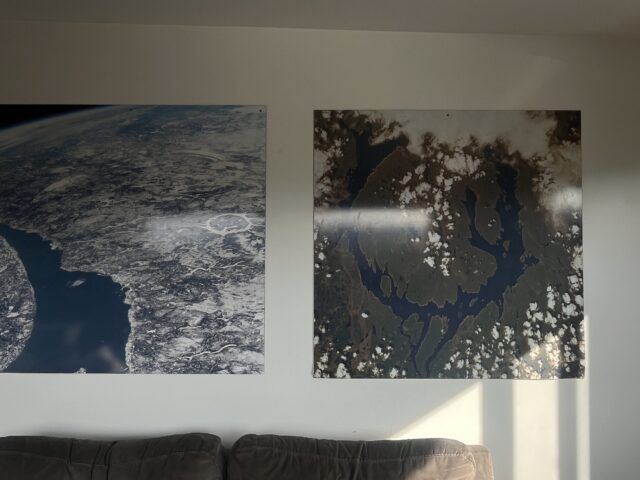
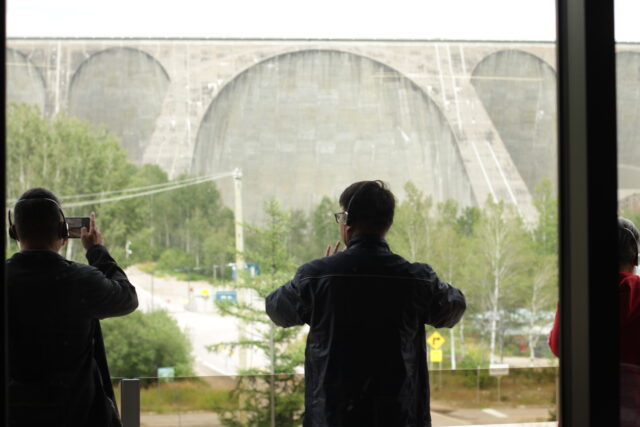
We were given hard hats and loaded onto a full school bus. Our first stop was the generating rooms where we navigated metal catwalks past massive control valves and through the turbine service areas. Despite the forces being harnessed and the amount of electricity being generated, these areas seemed very sparse with just a steady hum.
Our next stop on the tour was at the base of the dam in one of the cathedral-like spaces between the massive cement buttresses. This is the largest multiple-buttress dam in the world and the scale is hard to capture in pictures. It started generating electricity in 1970 and after some upgrades now generates 2660MW of power.
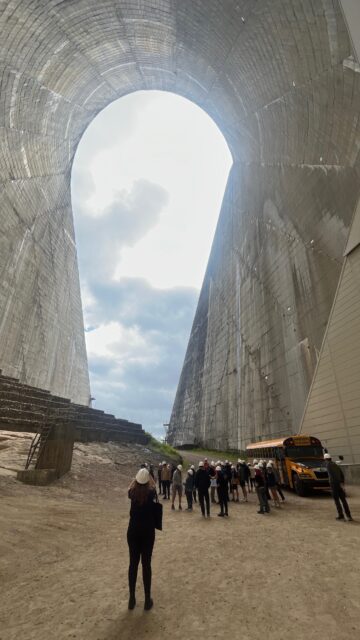
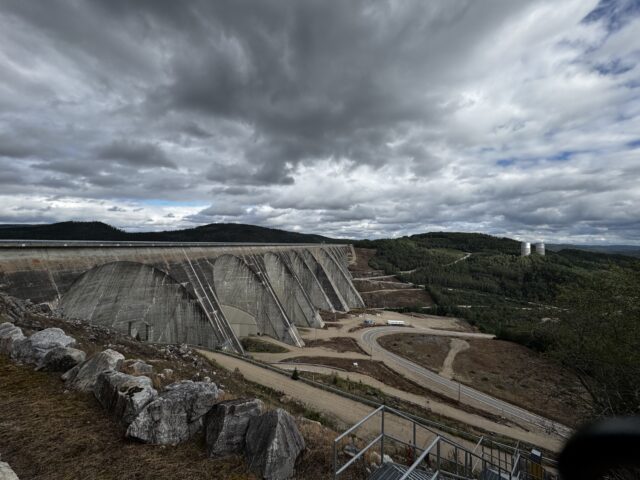
Manic-5 is one of 61 hydro generating stations scattered throughout the province. Now every time I turn on the table saw or soldering iron, I will think about the infrastructure required to deliver this clean renewable electricity to the Therevox shop.
Waveform Magazine Therevox Interview
July 18th, 2024 posted by mike under Therevox News.Waveform Magazine is probably my favourite magazine: legit interesting interviews and products from very creative synth people printed on actual physical paper! I met Ellison the editor of Waveform at Knobcon last year and we spent at least two hours in the hotel lobby talking about bicycles, nature, Vermont, probably politics, and even synthesizers. A few months later we reconnected over video chat for a proper interview that was published in Waveform Issue 13. Here is a PDF version of the interview portion, but check out the whole magazine if you get a chance!

New Northern Shop
January 8th, 2024 posted by mike under Workshop Updates.After finishing the most recent batch of ET-5 instruments, we packed up over 280 individual boxes and swept the floor of the old shop one last time and moved north. The last shop gave us room to grow the operation over the last 7 years, but the old building was impossible to keep warm during winter and the rusted-shut windows didn’t help during summer.

The new space is powered almost entirely by renewable energy (mostly hydroelectric) and heated by electric radiant floor heating. So far the space has been very cozy during the northern winter, and we’ll find out how the passively cooled design works during the summer – but at least the windows open.


The electronics lab now has an adjustable-height workbench and a larger assembly table. We’ve also moved the 3d printer to a full enclosure and added more shelf space.


The woodworking area is nice and bright with high-cri flicker-free LED lighting and we should have enough space to work on bicycles after hours. I wanted to share these pictures before everything gets messy and dusty as we start on a new batch of ET-5 instruments!
Improving our Tweed Road Case
December 17th, 2021 posted by mike under Therevox News, Workshop Updates.To accommodate for the larger playing area in the ET-5, the outside dimensions had to change compared to the ET-4. This gave me the opportunity to rethink our Tweed Road Case and to ultimately design a better case for our synthesizers.
The Original Tweed Road Case

Melissa evaluating case hardware for the first case.
Designing our very first case and the ability to build it in-house was definitely an uphill battle. We wanted the perfect case. First we visited with a local flight case designer, whose heavy industrial cases are used by touring bands around the world. While the case certainly offered a lot of protection, they are extremely heavy with aggressive steel corners. We then met with case hardware manufacturers Penn-Elcom, whose headquarters is not to far from our shop. Their aluminum extrusion system looked ideal for the “every day case” that we had in mind. At the time, Melissa was doing a lot of textile work and we found ourselves in stores looking at various tweed fabrics. Once we figured out how to laminate that tweed onto the plywood sides of our new cases, the Therevox Tweed Road Case was born.

The final batch of Tweed Road Cases in the Therevox shop.
Approximately 50 cases were built from 2012-2018, with all of the inside foam cut with my Mom’s electric turkey knife. While I am proud of our first attempt at building a case, there were a few issues that I wanted to address now that I was given the opportunity of redesign. The case was heavy, despite using hollow aluminum. The aluminum extrusions often arrived scratched from Penn-Elcom, forcing us to return many pieces and wait for replacements. While the accessory area allowed for the power supply and expression pedal to be carried, this resulted in a heavy case that was not comfortable to carry for long periods of time. In fact, during a trip to Montreal I had to improvise and add wheels to the bottom of the case to easily move it down streets and through subway stations.

Our initial and subsequent tweed fabrics were discontinued, so the case was made in 3 variations from 2012-2018
The New Case Tweed Hard Case
For 25 years I have been carrying around my favourite guitar in a standard hard shell case and it has suited the job perfectly. I wanted the exact same style case but for the ET-5. We reached out to the Canadian manufacturer that made my guitar case and talked to them about building one for the ET-5. After we had our specs and drawings made up, we went to the task of finding a new tweed fabric that would match the new case styling. To make the case as small and light as possible, I decided to get rid of the accessory section of the case. It is still possible to fit the power supply and a few cables in the case on top of the ET-5 fingerboard, and the padded handle is a lot more comfortable than the old strap-stype handle.

Anodized aluminum logo plate
We ordered hundreds of samples of fabric and tolex coverings and after going through them all, Melissa and I came to a very nice combination that I’m very happy with. The new case feels like a piece of vintage luggage and fits the ET-5 like a glove. While I am sad to see the old case go, this case is definitely an improvement.

New padded handle and tweed fabric.
The new Tweed Hard Case is available now for $350 USD.
ET-5 Development
March 3rd, 2021 posted by mike under Uncategorized.My “ET-5” folder has files in it dating back from January 2018. It’s hard to believe that the ET-5 has been in development for that long, especially considering that the instrument appears on first-glance largely the same as the ET-4 it is replacing.
The first sketches were all over the place. Extra knobs and features everywhere, some had keyboards, some had additional intensity keys and oscillators. These sketches lacked focus and were quickly abandoned. In the summer of 2018, Melissa and I were in New York attending the Hackers on Planet Earth conference and I had the opportunity to visit with several Therevox customers in the area. During the course of the next twelve months, we also visited customers in Montreal, Chicago and Los Angeles. Some of these visits became part of the Talking Synths video series, and some meetings just involved discussing composing, production, and gear – lots and lots of gear. Around this time myself and several friends co-founded “Signal Exchange”, the local synthesizer collective focused on social discussion and group noise-making.
On the 7 hour flight back from Los Angeles, I nearly filled up my entire notebook with ideas and illustrations. I had shown sketches and ideas to my customers and received inspirational feedback from some awesome people. By the end of the flight, I had most of the nitty gritty details figured out – like how a voltage controlled FX loop mixer should work to preserve the trails of a delay pedal. After that trip, the design was very clear: Instead of re-inventing the wheel, the ET-5 was going to take the ET-4 reconsider every aspect and improve on it. No change for change’s sake, no hype, just informed and tested improvements.

Above: The first ET-5 prototype test-bed with dynolabels, bare-steel panel and hardware store wood.
Being able to see how our customers use their Therevox and how it integrates with their music-making environment informed the design of the ET-5. Also the local synthesizer collective meetings have been a great resource for hands-on experience with new and vintage synthesizers. These meetings refined my taste in filters and contributed to the design of the new 3-pole filter, and was definitely responsible for the inclusion of a 5-PIN DIN MIDI output being added to the ET-5.
In the last few years I have also started delving deeper into the Ondes Martenot, an instrument that the Therevox owes much of it’s expressiveness. When the ET-4 was designed in 2010, documentation of the Ondes Martenot was sparse at best. Since that time, I have translated academic literature, books and papers to better understand the Martenot and do it justice while moving the sonic possibilities towards something new. This research informed the redesign of the intensity keys and ring. The feeling of the new intensity keys provides a progressive tactile resistance that increases proportionally with output amplitude in a curve similar to the original Ondes Martenot. The ring has also been redesigned to significantly reduce friction, making the movement easier and faster and more accurate. This required designing several new custom parts, but it was definitely worth it.

Above: An early ET-5 prototype circuit board after many changes.
In 2010, the ET-4 was laid out and designed on graph paper with a pencil and eraser (with eraser shield!) and then transferred to 2-dimensional CAD. At Knobcon 2018, I met with Roger Linn and during a discussion about design he strongly recommended that I move to a full-fledged 3-dimensional CAD package moving forward. This made designing the ET-5 a lot more immediate: being able to visualize new parts and layouts immediately. This also let me use available space more efficiently and allowed for more than half-octave of extra fingerboard room on the ET-5. If there is any drawback to computer aided design, it becomes apparent if you are a perfectionist. I spent months moving knobs and switches around by the millimeter until Melissa and I agreed that the instrument had a visual balance and rhythm.
Now that the first ET-5 is finished, we will be finishing up several more that are going to the first people on the waiting list for further testing and feedback. After that, any changes will be made and we will start on the first full-scale production run. Like the ET-4, the ET-5 Series will consist of several models so we can make models available at more affordable prices with different features. Those that sign up for the Waiting List will be able to choose what model they want before the build starts. We will also revisiting the design of the Tweed Road Case and eventually the EXP-1 Expression Pedal to make improvements and posting more progress pictures to our instagram.


